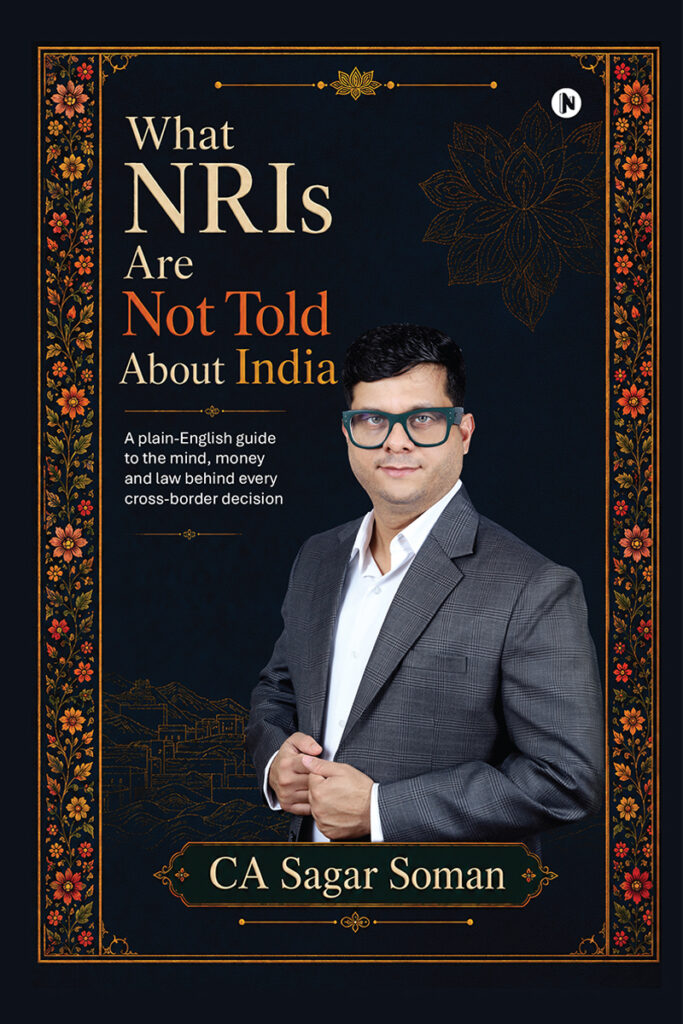
Your career may be abroad. Your wealth may be spread across countries. But India remains part of your financial life. Have you understood what that really means?
By CA Sagar Soman | Published 2026
A technology professional in California. A business owner in Dubai. A doctor practising in London. A banker in Singapore. An Indian family settled in Canada. A professional planning to return from Australia.
Different countries. Different careers. Different financial circumstances.
Yet somewhere in their lives, the same questions keep appearing.
- Can I send this money back abroad?
- What happens to my investments when I return to India?
- Will my Indian insurance policy be taxable in the country where I live?
- Can my children inherit the property and investments I own in India?
- What happens to the wealth I have accumulated across two countries?
And perhaps the most personal question of all:
After building a life abroad, where do I truly belong?
For millions of Indians living overseas, these are not abstract questions. They sit behind decisions about careers, family, investments, retirement and the next generation.
What NRIs Are Not Told About India explores this world through an unusual combination of lived NRI experience, financial understanding, regulatory awareness and responsible advisory thinking.
Written by Chartered Accountant Sagar Soman, the book follows the financial life of an NRI from the decision to live abroad to the questions of banking, taxation, investing, returning to India and passing wealth to the next generation.
It also introduces three original frameworks that connect the journey: the Compliance Highway Rule™, the NRI Kaalchakra™ and the NRI INDIA Mantra™.
The book is intended for individual NRIs and their families, as well as financial advisors, relationship managers, insurance professionals, compliance teams and institutions that work with the global Indian community.
Available in paperback, hardcase and ebook editions.
Amazon India | Flipkart | Amazon US | Amazon UK | Kobo ebook | Google Play Books
Why this book matters to an NRI
An Indian living abroad often has two financial lives.
One belongs to the country where the person works, earns, saves and builds a future.
The other remains connected to India.
Parents may live here. Property may be owned or inherited here. Bank accounts, insurance policies and investments may continue for years. There may be family responsibilities, plans to return, or children who will eventually inherit assets across countries.
The two financial lives do not always follow the same rules.
An Indian investment may be permissible under FEMA but carry separate tax or reporting consequences in the country where the investor lives.
An NRE account may be useful for a particular banking purpose without determining the taxation of every underlying receipt.
A foreign retirement account may be recognised under one country’s tax system without receiving identical treatment under Indian law.
A nomination may help an institution process a claim without resolving every question of inheritance.
And returning to India may change the way different legal systems treat the same person.
These are distinctions that can affect real financial decisions.
Yet the information NRIs encounter is often fragmented. One explanation concerns taxation. Another concerns investments. A bank explains its account rules. An insurer explains policy benefits. A family member offers an opinion based on personal experience.
The difficulty comes when all those pieces must fit together.
The book helps readers recognise the larger financial picture behind decisions that may initially appear straightforward.
Its purpose is not to turn every NRI into a tax professional. It is to make individual readers more aware of the questions they should understand, the assumptions they should examine and the boundaries of the information they receive.
For professionals, it provides a connected way to approach NRI financial conversations instead of treating them as ordinary domestic transactions.
For families, it creates a basis for discussing money, responsibility and future plans across generations and countries.
The life behind the NRI label: Where this book begins
Most books about finance begin with money.
This one begins with the person.
The opening chapter, Understanding the NRI: The Life Behind the Label, draws from Sagar Soman’s own lived experience of being an NRI.
Having lived outside India himself, Sagar understands the experience of building a life abroad while remaining emotionally, financially and culturally connected to India.
That perspective is central to the book.
Consider what happens when someone leaves India for a promising career.
There is excitement. A new country, a new job, better opportunities and the satisfaction of being able to support the family.
But there is another side that rarely appears in financial presentations.
Parents grow older while their children are thousands of kilometres away. Family celebrations become video calls. Important decisions must be made across time zones. The familiar support system disappears, and financial responsibility increasingly rests on the individual.
A successful professional in Singapore may still worry about parents in India.
A family settled in Toronto may struggle with the question of whether their children will ever want to live in India.
An executive in Dubai may maintain Indian investments partly because the idea of eventually returning home has never disappeared.
A technology professional in California may have accumulated substantial assets abroad while remaining uncertain about what to do with those assets if the family relocates to Bengaluru or Hyderabad.
There is a common thread.
The NRI may have left India physically without ever removing India from the family’s financial future.
The first chapter explores the sacrifices, cultural adjustments, responsibilities, aspirations and sense of belonging that accompany this experience.
It also examines why NRIs are drawn towards familiar investments and financial arrangements in India, even when their lives have moved elsewhere.
This emotional foundation is not separate from the technical chapters that follow. It explains why those technical questions exist in the first place.
Before understanding an NRI’s money, it helps to understand the life that money is meant to support.
That is the starting point of the book.
A financial journey that follows you across borders
The book does not assume that every NRI has the same circumstances.
A young professional leaving India faces different questions from an established business owner in the Gulf.
An OCI family settled abroad may have different concerns from an Indian citizen temporarily working overseas.
Someone who intends to remain abroad permanently may approach Indian investments differently from someone preparing to retire in India.
And a family whose children hold foreign citizenship may eventually face succession and ownership questions that were never considered when the original assets were purchased.
The book connects these circumstances through five broad stages.
- Building a life abroad. Understanding the NRI’s identity, family responsibilities, financial behaviour and the importance of correct legal classification.
- Managing money across countries. Understanding bank accounts, remittances, insurance, taxation and the consequences of moving funds.
- Making investment decisions involving India. Examining eligibility, investment routes, taxation, costs, repatriation and international financial arrangements, including GIFT IFSC.
- Returning home and preparing the next generation. Recognising the effects of changing residence, overseas assets, retirement arrangements, inheritance and family documentation.
- Developing responsible financial decision-making. Understanding why proper questions, evidence and professional boundaries are essential to cross-border financial matters.
Each stage matters independently. Together, they explain why an NRI’s financial life cannot always be understood through isolated product explanations or a single set of domestic rules.
Inside the book: Five parts, ten chapters
Part I. The NRI Mind and the Compliance Map
Chapter 1: Understanding the NRI
The Life Behind the Label
The first chapter captures the human experience of being an NRI, informed by Sagar Soman’s own life outside India.
It explores the sacrifices behind migration, the cultural shift from shared family decisions to individual responsibility, the emotional pull of India, the comfort of familiar investments and the deeper meaning of remittances.
For individual readers, the chapter offers a recognisable portrait of life between countries.
For family members, it provides perspective on the responsibilities and uncertainties that may sit behind financial decisions made abroad.
For advisors, it establishes why understanding the individual is essential before discussing an investment, account or insurance policy.
Chapter 2: Selling Across Borders
The Compliance Highway Rule™ Every Advisor Must Know
The second chapter moves from personal circumstances to the legal and regulatory environment surrounding NRI decisions.
It introduces the Compliance Highway Rule™ and explains why the description ‘NRI’ cannot be treated as a complete legal classification.
Citizenship, OCI status, residential status and the nature of a financial transaction may each require separate attention.
For individual readers, this chapter helps explain why a transaction that appears routine may prompt several different questions.
For NRI-facing professionals, it addresses the discipline required before recommending, explaining or facilitating financial arrangements across borders.
Part II. Money Routes and Tax Consequences
Chapter 3: Banking for NRIs & Claim Credit Rules
NRE, NRO, FCNR(B) and the Legal Rail of Money
A person may hold money in India for years without examining whether the account through which that money moves remains appropriate.
This chapter examines NRE, NRO and FCNR(B) accounts, along with the distinction between moving money, holding it, repatriating it and receiving proceeds from financial products.
Imagine an Indian working in Dubai who sends money home regularly, maintains deposits and holds an Indian insurance policy.
Or a family in London that receives rent from an inherited Indian property and later wishes to move the proceeds overseas.
The relevant banking and FEMA questions depend on the person’s status, source of funds, transaction and applicable route.
The chapter helps readers understand why these distinctions matter and why the original source and subsequent movement of funds deserve attention.
It also addresses insurance claim-credit arrangements and why receiving a claim is different from determining succession rights.
Chapter 4: Insurance Taxation for NRIs
What They Don’t Tell You
An insurance policy purchased in India can remain part of a person’s financial life long after the policyholder moves abroad.
What happens when the policy matures? What if premiums were funded through different accounts? What if the person has become tax resident in another country?
A benefit that receives particular treatment under Indian income-tax law may still raise questions under the tax and reporting laws of the country of residence.
The chapter examines these distinctions, the role of treaties where relevant, and the importance of policy terms, residence and documentation.
It is useful both to NRIs holding Indian insurance policies and to professionals responsible for explaining those policies.
Part III. The India Decision
Chapter 5: NRI Investment Reality Check
Why India Is Easy to Love, But Not Always Easy to Invest In
The investment decisions of an NRI may be shaped by two powerful influences.
The financial opportunities available in different markets, and the emotional familiarity of India.
Consider a professional in Dubai comparing an Indian fixed deposit, an Indian mutual fund, a residential property and an investment held through an overseas brokerage account.
Each option may appear attractive for different reasons.
But the comparison cannot end at expected returns.
Eligibility, account route, currency, taxation, costs, repatriation and residence-country implications may all influence the decision.
The chapter explores these considerations across Indian financial and investment arrangements.
It is especially relevant to NRIs whose investments in India form part of a larger international portfolio.
Chapter 6: GIFT City: India’s GIFT for NRIs
The International Finance Gateway Inside India
GIFT IFSC has become part of India’s expanding international financial landscape.
For NRIs, OCIs and other eligible investors, it introduces financial arrangements that require understanding a distinct regulatory setting.
The chapter discusses the purpose of GIFT IFSC, the nature of available financial routes, eligibility and the questions surrounding currency, taxation, costs and repatriation.
It also explains why a financial product’s location in an international financial centre does not automatically determine its suitability or remove obligations under other applicable laws.
Part IV. Return, Legacy and Evidence
Chapter 7: Retiring in India
Myth, Masterplan and the Trap of Return
This chapter addresses one of the most significant transitions in an NRI’s financial life.
Returning home.
For some, the decision begins with ageing parents. For others, retirement, children, lifestyle or the desire to reconnect with India changes the family’s priorities.
A couple returning from Australia may have foreign retirement savings, Indian property and bank accounts in two countries.
A technology professional leaving the San Francisco Bay Area for Hyderabad may hold employer shares, RSUs, a 401(k), an IRA and a US brokerage portfolio.
A family returning from the United Kingdom may have pension rights, overseas investments and Indian financial commitments.
The underlying question is similar: what happens when a financial life built abroad begins moving back towards India?
The chapter examines return planning through the distinction between FEMA residence and Indian income-tax residence, the relevance of NR, RNOR and ROR classifications, foreign retirement assets, banking arrangements and reporting consequences.
It introduces the NRI Kaalchakra™ as a way of understanding why the timing of life events and legal transitions matters.
For readers contemplating a return, the chapter explains why relocation involves substantially more than transferring savings and changing an address.
Chapter 8: Legacy, Law & Liability
The Inheritance Trap for NRIs
What happens to everything an NRI has built when the next generation must take responsibility for it?
This question reaches far beyond investments.
A family may have Indian property, overseas assets, bank deposits, insurance policies, demat holdings and relatives living in several jurisdictions.
An NRI may have named nominees in multiple accounts, prepared a will or assumed that family members will eventually sort out the paperwork.
But nomination, legal ownership, inheritance and transmission are not identical concepts.
This chapter examines those distinctions, along with wills, heirs, family circumstances and documentation.
It also addresses questions that can arise when children hold foreign citizenship or family members live in different countries.
For individual NRIs and their spouses, this is a chapter about preparing for the people who may eventually have to manage the assets they leave behind.
Chapter 9: Best Practices That Build Credibility
The File That Protects the Client, the Family and the Advisor
Financial decisions are often explained in conversations. Years later, those conversations may be difficult to reconstruct.
When a bank, regulator, insurer, tax authority or family member asks a question, what matters is whether the relevant facts and documents can establish the position.
This chapter examines documentation, evidence, professional responsibilities and the importance of maintaining a clear financial record.
Although directed substantially towards advisors, the underlying message is relevant to NRI families.
Financial knowledge matters. So does the evidence needed to support ownership, transactions, claims and family decisions.
Part V. The Operating Standard
Chapter 10: The NRI INDIA Mantra™
Before You Advise an NRI on India, Apply INDIA
The concluding chapter brings the entire journey together.
After examining the person, banking arrangements, tax consequences, investments, return planning, inheritance and documentation, the book introduces its final operating discipline.
The NRI INDIA Mantra™ is designed for approaching NRI financial conversations with a structured understanding of the person, transaction, applicable systems and evidence.
This chapter gives the book particular relevance as professional educational material.
For individual readers, it provides insight into the care that should accompany explanations and decisions involving cross-border money.
For institutions and advisors, it connects the subjects covered in the earlier chapters with responsible professional conduct.
What individual NRIs and their families can take from this book
The book’s value to a family lies in the connections it helps readers recognise.
For an NRI building wealth abroad, it offers a wider understanding of how Indian banking, investments and financial obligations may interact with life in another country.
For someone planning to return to India, it identifies the importance of residential status, timing, foreign assets, banking and retirement arrangements.
For an NRI with investments and property in India, it highlights the questions that can arise around ownership, taxation, movement of funds and eventual inheritance.
For a spouse, it provides insight into financial arrangements that may otherwise be understood mainly by the person who originally opened the accounts or made the investments.
For parents and adult children, it introduces the issues that may arise when Indian assets, foreign citizenship, succession and family responsibilities intersect.
The book does not attempt to settle every personal tax, legal or investment question. It helps readers understand why those questions deserve attention and what kinds of distinctions can change the answer.
A successful financial life involves more than accumulating assets.
It also involves understanding the responsibilities that accompany them.
Why this book is relevant to financial advisors and institutions
For financial professionals and organisations serving NRIs, the book offers a connected educational approach to a subject that is frequently taught in separate pieces.
A relationship manager may understand NRE and NRO accounts but encounter questions about inheritance or changing residential status.
An insurance advisor may know the features of a policy but need to recognise where Indian tax treatment, foreign-country obligations or claim-credit rules require separate examination.
A wealth professional may understand investments but encounter unfamiliar questions involving FEMA, repatriation or the client’s future return to India.
A compliance or training team may need to explain why similar-looking transactions can produce different outcomes depending on residence, ownership, funding and supporting documents.
The book addresses the thinking required to recognise these boundaries.
For individual advisors and relationship managers
The chapters on the Compliance Highway Rule™, banking, insurance taxation, investment decisions and documentation provide an educational basis for more careful NRI conversations.
Rather than offering a sales script, the book encourages readers to understand the client, identify the relevant questions and avoid assurances that go beyond the facts.
For insurance companies and financial-services institutions
The book’s structured progression is relevant to professional learning discussions about NRI customer circumstances, cross-border product questions, account routes, regulatory boundaries, documentation and responsible communication.
Chapters 2, 3, 4, 9 and 10 are particularly relevant to these themes.
The material can serve as a common reading reference for teams whose responsibilities involve different parts of the NRI financial journey.
For banks, wealth teams and compliance functions
The book helps connect customer circumstances with the regulatory and practical questions that may be encountered during onboarding, account management, investment discussions, remittances, claims and later changes in residence.
It also reinforces the importance of recognising when a matter needs examination under another legal or professional discipline.
For professional and institutional education
The three frameworks provide a common conceptual language for discussing NRI financial decisions.
The book can be used for individual study, reading groups and discussions within learning or compliance functions, subject to the organisation’s own requirements.
It is not an institution-specific compliance manual, accredited programme or substitute for current regulatory training. Its contribution is the broader way of thinking that connects different parts of the NRI journey.
The central lesson for professionals is simple: understanding the product is necessary. Understanding the person, the transaction and the applicable rules is equally important.
Three original frameworks behind the book
One of the distinguishing features of What NRIs Are Not Told About India is the use of three connected frameworks developed by CA Sagar Soman.
They are designed to bring structure to complicated NRI financial conversations without suggesting that any single framework can replace the applicable law.
The Compliance Highway Rule™
The framework provides a conceptual map for identifying the different legal and regulatory questions involved in cross-border financial matters.
The NRI Kaalchakra™
The framework focuses on timing and the changes that occur as an individual’s residential and financial circumstances move across countries and life stages.
The NRI INDIA Mantra™
The framework connects knowledge with professional discipline, encouraging a structured approach to understanding and communicating NRI financial decisions.
The book develops these concepts throughout the chapters and brings them together in its concluding section.
Read the introduction to the three frameworks.
About the author
CA Sagar Soman is the author of What NRIs Are Not Told About India and the creator of the Compliance Highway Rule™, the NRI Kaalchakra™ and the NRI INDIA Mantra™.
He is a Chartered Accountant whose writing focuses on India-side income tax, FEMA, banking, remittance, reporting, investment and succession issues involving NRIs, OCIs, returning Indians and internationally connected families.
Having lived outside India himself, Sagar brings a personal understanding of the NRI’s connection with India.
This experience informs the opening chapter, which explores life abroad through the perspective of the individual and the family before moving into technical financial and regulatory questions.
The book combines that human understanding with an emphasis on careful questioning, distinguishing legal systems and responsible financial communication.
It reflects the view that cross-border financial decisions should be understandable without ignoring the distinctions that matter.
Read more about CA Sagar Soman.
A book worth reading before the next major financial decision
An NRI’s connection with India may change over time.
At twenty-five, the focus may be education and employment abroad.
At thirty-five, it may be building wealth, buying a home, raising children and supporting parents.
At forty-five, questions about investments, property, international assets and returning to India may become more significant.
At sixty, retirement, family responsibilities and succession may take centre stage.
There is no universal timeline. Every family is different.
But the questions that follow these transitions deserve attention.
What NRIs Are Not Told About India brings those questions into one connected narrative.
For the individual NRI, it is an opportunity to understand the financial life that connects two or more countries.
For the spouse or family member, it is a way to become more familiar with decisions that may eventually affect the entire family.
For the professional or institutional reader, it is an educational resource for approaching NRI financial matters with greater care.
The book’s central subject is the global Indian. The person who may live thousands of kilometres away from India while continuing to make some of life’s most important decisions with India in mind.
Because the wealth you build is important. So are the people, responsibilities and decisions that give that wealth its purpose.
Book details and available editions
- Title: What NRIs Are Not Told About India
- Author: CA Sagar Soman
- Publication year: 2026
- Language: English
- Contents: Five parts, ten chapters, Author’s Note, introduction to the three frameworks and Professional Note.
- Paperback: ISBN 979-8-90540-871-7
- Hardcase: ISBN 979-8-90540-916-5
- Ebook: Digital edition
Where to buy What NRIs Are Not Told About India
Choose your preferred edition and retailer.
India
International
Digital editions
Retailer pricing, edition availability, international delivery and format selection are determined by the respective stores.
Publication note: This book is educational and reflects its publication context in 2026. It does not provide personalised tax, FEMA, legal, investment, insurance, succession, immigration or foreign-country advice. Applicable rules and procedures may change. Individual outcomes depend on the relevant jurisdiction, period, facts and documents. Readers should verify current law and obtain appropriately qualified advice where required.